

Managing multiple service projects means coordinating activities, deadlines, and resources across different customer commitments. As priorities change, activities move, and resources are shared across projects, decisions made for one project can affect others. Keeping projects on track therefore requires more than knowing when individual tasks are scheduled. Planners also need to understand how activities depend on one another and whether the resources required to complete the work are available.
A Gantt chart helps make these relationships visible by showing scheduled activities along a timeline. Combined with a resource view of assignments and workloads, it gives planners one picture of what is scheduled, how the work is connected, and whether the people needed to deliver it are available.
Why use a Gantt chart instead of a spreadsheet or task list?
Spreadsheets and task lists can be useful for organizing project activities and tracking deadlines. For relatively small and stable schedules, they may be sufficient. The limitations become more apparent when several projects run simultaneously and schedules change frequently. Activities are moved, resource availability changes, and new priorities need to be accommodated.
A Gantt chart represents activities as bars along a timeline, showing their planned start and finish dates. This makes it easier to examine how activities are positioned over time, which tasks overlap, and how the sequence of work develops. When dependencies are included, planners can also see which activities are linked and where a scheduling change may affect subsequent work.
However, understanding the project timeline is only one part of project scheduling. The resources required to complete the work also need to be considered.
Why project scheduling needs both a project Gantt and a resource Gantt
A project timeline may look achievable until the resources needed to deliver it are taken into account. The same resource may be allocated to activities across several projects at the same time.
This is why project scheduling requires two complementary perspectives:
- Project Gantt: Shows project activities, timelines, and dependencies, helping planners understand what needs to happen and when.
- Resource Gantt: Shows scheduled work by resource group or individual resource, helping planners understand assignments and workloads across projects.
Neither perspective provides the complete picture on its own. A change to the project schedule needs to be considered alongside resource availability. Likewise, moving work to an available resource still needs to make sense within the project's timing and dependencies. Workload and capacity information provides additional context, helping planners identify available capacity and potential overloads.
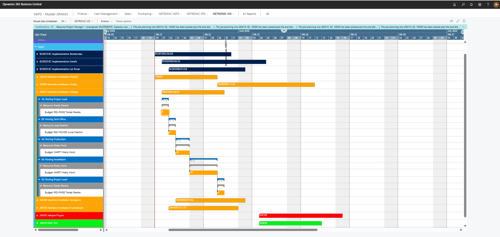
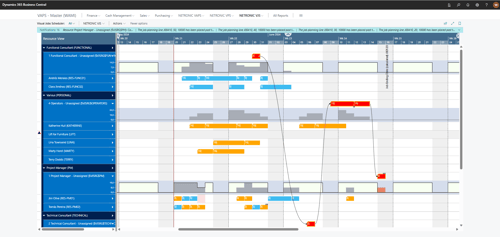
Project Gantt chart in Business Central Resource Gantt chart in Business Central
How to visualize project schedules in Business Central
For companies using Microsoft Dynamics 365 Business Central, project tasks, planning lines, and resource information are already maintained in the ERP system. The challenge is understanding how these elements relate to one another across time and multiple projects. Visual scheduling makes these relationships easier to examine by bringing project timelines, dependencies, resource assignments, and workloads into a graphical schedule.
Netronic's Visual Jobs Scheduler (VJS) adds this scheduling perspective directly within Business Central. With its project and resource Gantt charts, planners can examine schedules and capacity, spot late activities and overloaded resources through visual alerts, and adjust timing and assignments using drag and drop. When a predecessor moves, linked successor activities are rescheduled automatically, so planners do not have to update each dependent task by hand.
Because the schedule is built on the project and resource information already maintained in Business Central, planners can act on it without maintaining a separate scheduling system or keeping two sets of data aligned.
How a visual schedule supports scheduling decisions
What a Gantt chart adds is a clearer view of how activities, timing, and resources relate to one another. When planners can see project timelines alongside resource commitments and capacity, they have more information for evaluating scheduling changes and deciding how to respond.
Service project schedules will continue to change. Keeping projects on track depends on understanding the consequences of each change and having a practical way to manage it.
 Take a closer look at Gantt-based visual scheduling
Which scheduling capabilities a manufacturer needs depends on how production is planned and which constraints matter most. Our whitepaper, What Gantt charts add to production and project scheduling, takes a closer look at visual scheduling, resource capacity, task dependencies, and the role of more advanced scheduling functionality, with practical examples from Netronic's solutions for Business Central.

Frequently asked questions about service project scheduling
If you are looking for some more general facts about planning boards, our post
10 graphical functions a planning board should offer might be useful for you.